
Article at a glance: AI is reshaping how marketing agencies operate, hire and deliver value. For CMOs and marketing VPs considering how to choose a marketing agency, the old metrics — headcount, scale, hours billed — no longer tell the full story. This article outlines what to look for instead. The short answer: Look for senior-led teams, clear AI integration and impact over optics.
The traditional markers of agency value are fading fast.
For years, marketing leaders evaluated agency partners by headcount, office footprint and geography. Bigger meant better. More people meant more capacity. A sprawling team signaled an agency that could handle whatever you threw at it.
That calculus no longer holds.
According to our recent survey of 225 senior leaders, 57% of agencies have already slowed or paused entry-level hiring, and more than half expect significant headcount reductions within the next three years. The reason is straightforward: AI has matured to the point where it can execute core marketing functions at the level of a mid-career professional.
This shift has significant implications for how CMOs and marketing VPs should think about agency partnerships. If the agencies you’re evaluating are using AI, what exactly are you paying for? And how do you separate the partners positioned for this new era from those still clinging to an outdated model?
The end of scale as a proxy for agency value.
For decades, agency scale served as a shorthand for capability. A 200-person shop could field teams across PR, demand gen, creative and strategy. A 20-person firm could not.
AI has upended that logic. Today, a lean team equipped with the right tools can produce work that once required dozens of people. Content drafting, competitive research, media optimization and even creative concepting are functions that no longer demand large teams to execute at speed.
Consider this: Our study found that 58% of agencies now report AI is deeply embedded in their daily workflows. Meanwhile, over half have begun developing or deploying their own AI-powered agents. The technology isn’t experimental anymore. It’s operational.
This means headcount is no longer a reliable indicator of what an agency can deliver. A 10-person team with sophisticated AI integration may outperform a 100-person team that’s still staffing projects the old way.
What to look for now when choosing a marketing agency.
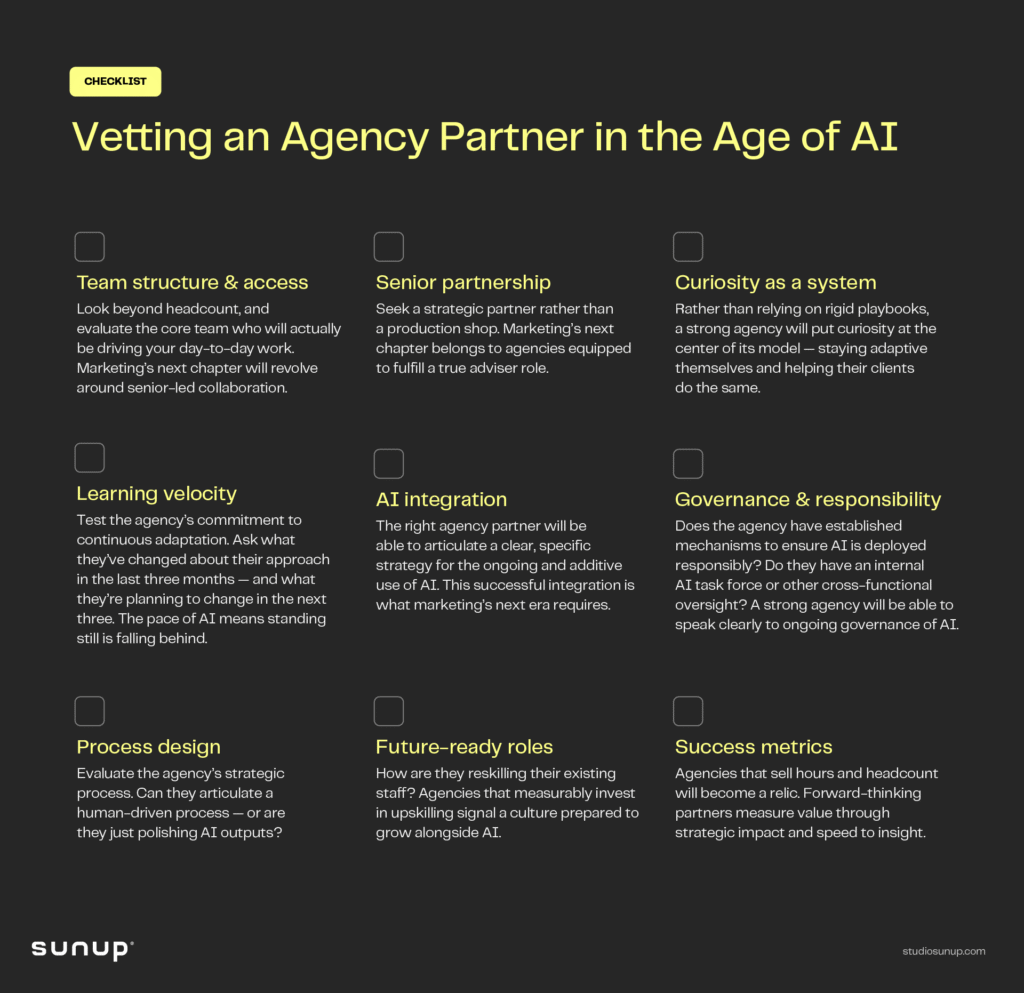
If scale isn’t the metric, what is? Based on our findings, three factors now distinguish agencies positioned for the AI era from those that aren’t.
Senior-led teams with direct client access.
As agencies consolidate, the ratio of senior to junior talent is shifting. Entry-level pipelines are contracting. What remains are experienced strategists and practitioners who can direct AI-augmented workflows and exercise the judgment that technology can’t replicate.
When evaluating an agency, ask who will actually be doing your work. If the answer involves layers of account coordinators and junior staff, that’s a red flag. The future belongs to smaller, senior-led teams where decision-makers are close to the work.
A clear AI integration strategy.
Every agency claims to use AI. Not all can articulate how.
When vetting partners, ask specific questions: What tools are embedded in their workflows? How do they govern AI use? What has changed about their process in the last six months? Agencies that can’t speak clearly to these questions are likely bolting AI onto old processes rather than rethinking how work gets done.
A model built on outcomes, not hours.
The billable hour made sense when agency value was measured in labor. It makes less sense when a task that once took 40 hours now takes four.
Forward-thinking agencies are moving toward models that price based on speed, quality and impact rather than time. If an agency is still selling you hours and headcount, ask yourself whether their incentives align with yours.
The shift from producer to partner.
One theme that emerged clearly from the research is a change in how agency leaders describe their own role. The language is telling: “trusted adviser,” “strategic partner,” “curator of insight and authenticity.”
This isn’t just positioning. It reflects a genuine shift in where agency value resides. When AI can generate a first draft of almost anything, the differentiator becomes knowing what to ask for, how to refine it and whether the output actually serves the strategy.
As one C-level executive in our study put it, agencies are moving from being solely creators of content to becoming curators of insight, context and authenticity. The implication for marketing leaders is clear: Seek partners who can think strategically, not just produce.
Speed, focus and seniority.
The agencies best positioned for this moment share a few common traits.
They’re fast — not because they have more people, but because they’ve rebuilt their workflows around AI-augmented execution. They’re focused — specializing rather than trying to be all things to all clients. And they’re senior — structured around experienced practitioners who can move fluidly between strategy and execution.
This is not the agency model of five years ago. It’s leaner, more nimble and more demanding of the people who remain. But for marketing leaders rethinking how to choose a marketing agency, it represents an opportunity: direct access to sharper thinking, faster turnarounds and tighter alignment between what you pay for and what you actually need.
Our full research report, “AI’s Effect on the Marketing Industry,” is available for download below.